Admission Enquiry Form
for UG/PG : admissions@dsuniversity.ac.in , for Ph.D : admissions.research@dsuniversity.ac.in
Helpline : +91 63841 76766 | 63841 76769

Admission Enquiry Form
for UG/PG : admissions@dsuniversity.ac.in , for Ph.D : admissions.research@dsuniversity.ac.in
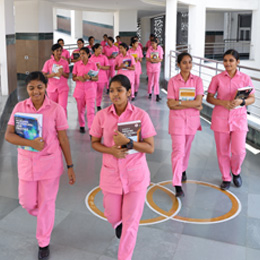
Helpline : +91 63841 76766 | 63841 76769The School of Nursing, Dhanalakshmi Srinivasan University, Chengalpattu, stands as a beacon of excellence in nursing education, research, and healthcare service. Under the visionary leadership of our Hon’ble Chancellor Shri. A. Srinivasan, the School is devoted to nurturing competent, compassionate, and ethical nursing professionals who embody care, commitment, and clinical expertise. With a strong foundation in scientific knowledge and hands-on experience, the School of Nursing blends academic rigor, evidence-based practice, and holistic education, shaping future nurses to meet global healthcare challenges with professionalism and empathy.

To emerge as a nationally and globally recognized centre of excellence in nursing education, research, and practice, dedicated to advancing health and transforming lives through compassionate care and innovation.

The School of Nursing at DSU aims to offer a comprehensive range of programs that integrate theoretical learning, clinical practice, and research competence — preparing nurses to deliver quality care in diverse healthcare settings.
The GNM program will provide a strong foundation in patient care, midwifery, and community health nursing. It focuses on developing the essential skills and knowledge required for professional nursing practice.
Bachelor of Science in Nursing (B.Sc. Nursing) – Duration: 4 Years
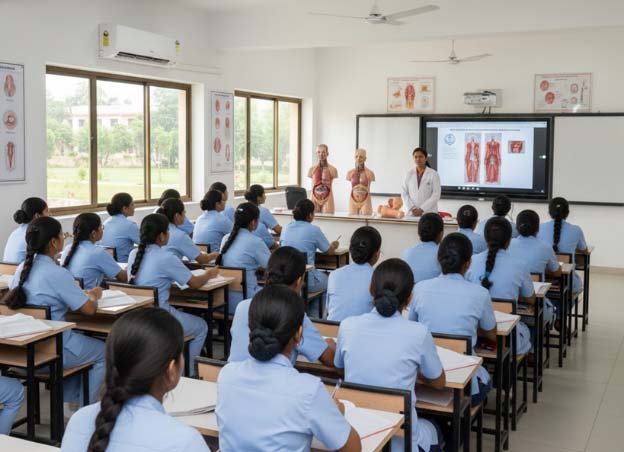
The B.Sc. Nursing program will prepare students to provide high-quality, evidence-based nursing care in hospitals, communities, and public health institutions. It integrates classroom instruction with extensive clinical and simulation-based practice.
The minimum age for admission shall be 17 years on 31st December of the year in which admission is sought.
10+2 class passed with Science (PCB) & English Core/English Elective with aggregate of 45% marks from recognized board under AISSCE/CBSE/ICSE/SSCE/HSCE or other equivalent Board.
Student shall be medically fit.
Students appearing in 10+2 examination in Science conducted by National Institute of Open School with 45% marks.
Student shall be admitted once in a year.
Master of Science in Nursing (M.Sc. Nursing) – Duration: 2 Years
The M.Sc. Nursing program will cultivate advanced practitioners, educators, and researchers in specialized nursing disciplines. It aims to empower graduates for leadership roles in clinical, academic, and public health sectors.
 |
 |
 |
The Ph.D. program will promote excellence in nursing research and leadership, focusing on innovation in healthcare, education, and community service.
The School of Nursing is designed to meet the highest standards of nursing education and healthcare training, ensuring that every student learns in an environment that inspires excellence.
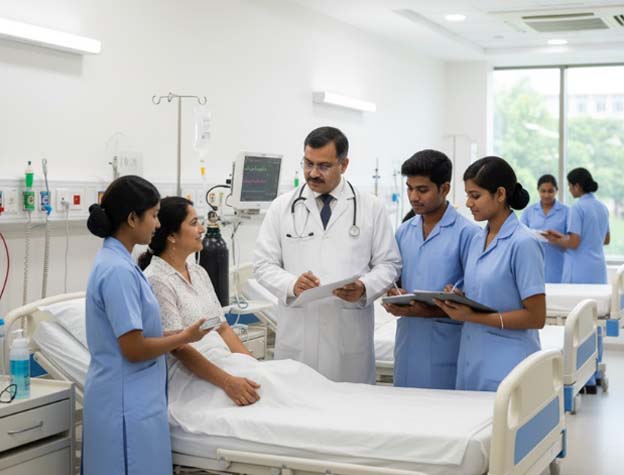
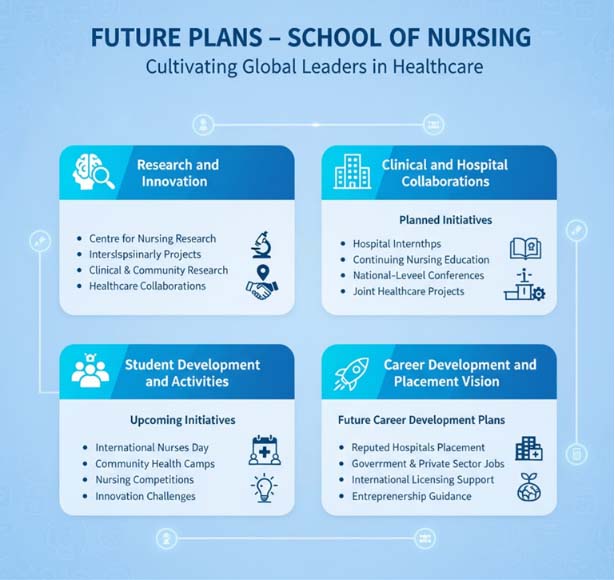
The School of Nursing, DSU, envisions continual growth through academic expansion, research leadership, and community service. The School aims to prepare global nursing professionals who lead with empathy, competence, and innovation.
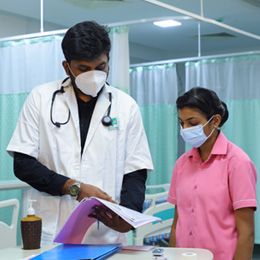
To provide real-world exposure and professional skill development, the School will expand its partnerships with leading hospitals and healthcare organizations.
The Nursing Students Association (NSA-DSU) will play a key role in fostering leadership, teamwork, and community spirit among students.
The School of Nursing will develop a strong Training and Placement Cell focused on preparing students for successful healthcare careers globally.
To position DSU Nursing graduates as globally recognized healthcare professionals who exemplify compassion, competence, and leadership in every sphere of nursing practice.
(Adapted from Indian Nursing Council)
We believe that,
The aim of the undergraduate nursing program is to
On completion of four year B.Sc. Nursing Program the graduate will be able to:
At the end of the course the B.Sc(N) Program the graduate nurse will be able to function as a General Nurse practitioner to provide comprehensive care / supervise and train nursing students at various health care settings and educational institutions and adhere to the code of Nursing Ethics.
Approved by Tamil Nadu Nurses and midwives council and Indian Nursing Council, New Delhi .
These regulations shall be called “THE REGULATIONS FOR THE BACHELOR OF NURSING DEGREE COURSE OF DHANALAKSHMI SRINIVASAN UNIVERSITY, Samayapuram”.
The regulation and syllabi are subject to modifications by the standing Board of Studies for nursing course from time to time.
The minimum age for admission shall be 17 years on or before 31st Dec. of the year of admission
The minimum educational requirements shall be the passing of: Higher Secondary school certificate Examination (12years course)
An equivalent with 12 years schooling from a recognized board or university with minimum of 45 % aggregate marks (40% marks for SC, ST, for MBC, OBC candidates in part – III subjects of Physics, Chemistry & Biology / Botany & Zoology) and should have English as one of the subject.
Candidate shall be medically fit.
Selection of the candidates should be based on the merit of the entrance examination held by university or competent authority or as per regulation of the University from time to time.
The period of certified study and training of the B.Sc. Nursing Degree course shall be of four academic years including internship.
| Available Weeks / Academic year | 52 Weeks |
|---|---|
| Examination (including preparation) | 4 Weeks |
| Vacation | 8 Weeks |
| Gazetted holidays | 3 Weeks |
| Available Weeks | 37 Weeks |
| Hours per week | 40 hours |
| Hours available per academic year | 1480 (37weeks x 40 hours) |
English shall be the medium of instruction for all the subjects of study and for examination of the course.
Each academic year shall consist of not less than 240 working days.
A Candidate admitted into B.Sc, Nursing Degree course of the DHANALAKSHMI SRINIVASAN UNIVERSITY, Samayapuram shall submit the prescribed application form for registration duly filled along with prescribed fee and declaration in the format, to the Admission Officer on or before the cut-off date prescribed for admission.
Examination will be conducted in both theory and practical as prescribed. The candidates will be permitted to appear for the University Examinations, only if they secure 80% of attendance in theory and practical for a subject irrespective of any kind of absence overall in a year.
The student should complete 100% of attendance in practical before course completion and the award of the Degree.
A student who does not meet the minimum attendance requirement in a year must repeat the course along with the next batch of students.
Internal assessment will be done in each subject of study and the marks will be awarded to the candidates as detailed in the scheme of examinations. Minimum Internal Pass Marks for theory and practical to be 50% individually. The minimum pass mark for theory is 13 out of 25.
The candidate appearing for arrear examination in the subject will have the same internal marks secured in the previous examination (1st attempt).
A checklist or criteria to be developed by the respective institutions for objective evaluation of assignments, records, reports, and clinical presentations.
The internal marks to be calculated based on the following criteria
| Criteria | Weightage | Marks rounded off to 25 | Marks rounded off to 50 |
|---|---|---|---|
| Best of three Unit test marks | 45% | 12 | 23 |
| Best of two Assignment marks | 25% | 6 | 12 |
| Model Exam | 30% | 8 | 15 |
| Total | 100% | 25 | 50 |
| Criteria | Weightage (100%) | Marks rounded off to 50 |
|---|---|---|
| Continuous assessment of Clinical Performance | 30% | 15 |
| Clinical assignment(Case study/ Practical record/Case book) | 20% | 10 |
| Clinical Presentation | 10% | 5 |
| Observational /field visit/ Health talk | 10% | 5 |
| Model Practical Examination | 30% | 15 |
| Total | 100% | 50 |
On Completion of Internship, Internal Assessment out of 100 marks should be sent to the University for inclusion in the mark list.
University examinations to be conducted after the completion of Eleven months of the course for the annual pattern. The University Examinations will be conducted in the annual pattern for all the four years from 1st week of August and supplementary exam in 1st week of February.
The particulars of subjects for various examinations and distribution of marks are detailed in the Scheme of Examination.
The examination for the main subjects will be conducted by the University and the marks for the internal subjects will be awarded by the subject handling faculty and forwarded to University by the concerned college.
Theory and Practical Exam for Introduction to Computer and Theory Exam or English to be conducted as College Exam and marks to be sent to University for inclusion in the mark sheet.
The Dhanalakshmi Srinivasan University Practical Examinations shall be jointly conducted by one internal and one external examiner duly appointed by the University.
To be an examiner the faculty should possess three years of experience after MSC Nursing as per the Dhanalakshmi Srinivasan University regulation. To be an examiner for nursing foundations course faculty having M.Sc. (Nursing) with any specialty shall be considered provided she / He currently handing the subject.
If a candidate fails in either theory or practical paper he/she has to re-appear for both the papers (Theory and practical).
A candidate should clear all arrear subjects before appearing for final exam in IV year.
All practical examinations must be held in the respective clinical areas.
Maximum number of candidates for Practical examination should not exceed more than 20 students per day.
| Criteria | Weightage (100%) | Weightage for 100 marks |
|---|---|---|
| Patient care at the bed side | 60% | 60 |
| OSCE in skill lab | 30% | 30 |
| Viva | 10% | 10 |
| Total | 100% | 100 |
The question paper setters need to submit the answer key along with question paper.
Students shall be permitted to use Simple calculator during Nursing Research & Statistics examination for both new and old syllabus.
A candidate has to pass in theory and practical exam separately in both internal and external examination of each paper.
A candidate has to secure minimum of 50% of marks in the University Theory and practical Examinations separately except for English.
Minimum pass mark for English shall be 40% only.
A candidate has to secure minimum of 50% of marks in Introduction to Computer.
A candidate has to secure minimum of 50% of marks in each Section A & B separately where two subjects are combined in single paper. If a candidate who has failed to secure the minimum pass mark of 50% either in Section A or B, the candidate has to write again both the sections irrespective the fact whether the candidate has passed in one section.
The candidates shall be eligible for the Degree of Bachelor of Nursing when they have undergone the prescribed course of study for a period of not less than four years in Dhanalakshmi Srinivasan University and have passed the prescribed examinations in all subjects.
The maximum period to complete the course successfully should not exceed a period of eight years.
A successful candidate obtaining 75% and more marks in the grand total aggregate at first attempt shall be declared to have passed with First class with Distinction.
A successful candidate obtaining 60% and more but less than 75% of marks in the grand total aggregate at first attempt shall be declared to have passed with First Class.
A successful candidate obtaining 50% and more but less than 60% of marks in the grand total aggregate at first attempt shall be declared to have passed with Second Class.
A successful candidate obtaining 60% and more in the grand total aggregate at second attempt shall be declared to have passed with Second Class.
A successful candidate obtaining 50% and more but less than 60% in the grand total aggregate at second attempt shall be declared to have passed with Third Class. Ranks shall be declared on the basis of the aggregate marks obtained by a candidate in the University Examination subjects of the course. Only those candidates who have passed all the subjects in all examination at first attempt shall be eligible for the award of Rank.
| S. No | Subject | Theory hrs (Class and Lab) | Practical hrs (Clinical) | Total Hours |
|---|---|---|---|---|
| First Year | ||||
| 1 | English | 60 | 60 | |
| 2 | Anatomy | 60 | 60 | |
| 3 | Physiology | 60 | 60 | |
| 4 | Nutrition | 40+20 | 60 | |
| 5 | Biochemistry | 30 | 30 | |
| 6 | Nursing Foundations | 265 + 200 | 450 | 915 |
| 7 | Psychology | 60 | 60 | |
| 8 | Microbiology | 45+15 | 60 | |
| 9 | Introduction to computers | 15 + 30 | 45 | |
| 10 | Regional Language | 30 | 30 | |
| 11 | Library Work /Self Study | 50 | 50 | |
| 12 | Co-curricular activities | 50 | 50 | |
| Total Hours | 1030 | 450 | 1480 | |
| Subject | Duration | Marks | ||||
|---|---|---|---|---|---|---|
| Internal Marks | University Marks | Total | ||||
| Min | Max | Min | Max | |||
| First Year | ||||||
| Theory | ||||||
| Anatomy & Physiology (A&B) | 3 | 12(6+6) | 25(12+13) | 38(19+19) | 75(37+38) | 100 |
| Nutrition & Biochemistry (A&B) | 3 | 12(7+5) | 25(15+10) | 38(23+15) | 75(45+30) | 100 |
| Nursing Foundations | 3 | 12 | 25 | 38 | 75 | 100 |
| Psychology | 3 | 12 | 25 | 38 | 75 | 100 |
| Microbiology | 3 | 12 | 25 | 38 | 75 | 100 |
| English * | 2 | 20 | 50 | - | - | 50 |
| Introduction to Computers * | 2 | 25 | 50 | - | - | 50 |
| Practical and Viva voce | ||||||
| Nursing Foundations | 50 | 100 | 50 | 100 | 200 | |
For all the single subjects
Essay questions : 2 x 15 marks = 30 marks
Short Notes : 5 x 5 marks = 25 marks
Short Answer : 10 x 2 marks = 20 marks
Total : 75 marks
| S.No | Subjects | Sections | No. of Essay questions (15 Marks) | No. of Short Notes (5 Marks) | No. of Short Answer (2 Marks) | Total Marks |
|---|---|---|---|---|---|---|
| 1 | Anatomy and Physiology | |||||
| Anatomy (37 Marks) | A | 1 | 2 | 6 | 37 | |
| Physiology (38 Marks) | B | 1 | 3 | 4 | 38 | |
| 2 | Nutrition and Biochemistry | |||||
| Nutrition (45 Marks) | A | 1 | 4 | 5 | 45 | |
| Biochemistry (30 Marks) | B | 1 (10 marks) | 2 | 5 | 30 | |
| 3 | Pharmacology, Pathology & Genetics | |||||
| Pharmacology (38 Marks) | A | 1 | 3 | 4 | 38 | |
| Pathology (25 Marks) | B | 1 (10 marks) | 1 | 5 | 25 | |
| Genetics (12 Marks) | - | 2 | 1 | 12 | ||
| 2 | Nursing Research and Statistics | |||||
| Nursing Research (50 Marks) | A | 2 | 2 | 5 | 50 | |
| Statistics (25 Marks) | 1 | 2 | - | 25 | ||